Contact

Plastic Recycling in the Construction Industry: Acting Together

Illustration of possible plastic components on construction sites, e.g. pipes, insulation material, window frames
Initial situation

Plastics play an important role in the construction industry due to their diverse range of applications (see illustration below). Around a quarter of Switzerland's annual plastic consumption is attributable to construction. However, little attention is currently paid to the plastics used when it comes to sustainability in the construction industry, even though the material recycling of plastics could contribute to reducing the environmental impact. By establishing a circular economy for plastics in the construction industry, the environmental impact of newly installed plastic components and the environmental pollution caused by the disposal of deconstructed products could be reduced by up to 200,000 t CO2 per year (see Circoplast report, 2023). In order for the deconstructed plastics to be recycled and used as a starting material for new components, existing hurdles must be removed and cooperation between all stakeholders involved must be improved.

project objective

Test construction sites were used to bring these stakeholders together directly during implementation so that solutions could be developed not only on the basis of theoretical concepts, but also with the help of real-life experience. The aim was to overcome or reduce barriers and prejudices against the recycling of plastics in the construction industry. The project "Plastics in the construction industry: acting together" was intended to raise awareness of the issue far beyond the stakeholders involved, demonstrate concrete implementation, and pave the way for widespread implementation.

This project was funded by the "Sustainable Development" program of the Federal Office for Spatial Development (ARE) and supported by other project partners. 

Test sites and workshops

As part of the project, separate collection of plastics was monitored at two test construction sites. It became clear that, depending on the approach taken, separate collection of different plastic components can be easily implemented directly on the construction site. Details about the construction sites can be found further down on this page. 

The findings were reflected upon with the various stakeholders during two exchanges. This resulted in new connections being made and a clearer understanding of which obstacles could best be tackled in the near future.

KST_Building
Overview of possible installed plastic products

Processed test construction sites

SVA Aargau Construction Site

SVA Aargau renovated its headquarters in Aarau. The existing two office buildings were demolished down to their concrete structure (load-bearing columns and some walls).

Arranged and financed by the Aargau Cantonal Economic Development Agency and Kunststoff.swiss, we were able to test initial approaches to the separate collection of plastics on a construction site. We were supported in this by the architectural firm Meier + Steinauer, which was responsible for project and construction management for the renovation, as well as the construction company.

Before the demolition work began, the installed plastics were identified together with the project management and a representative of the Aargau Canton business promotion agency. Based on this, different questions were developed, specifically tailored to the situation on this construction site. The challenge with this construction site was, in particular, the short time between the identification of the construction site and the start of demolition.

During a second inspection with the construction management and the responsible company, the further details regarding the collection of plastics were discussed. Subsequently, the employees of the deconstruction company separately removed various plastic products and collected them in a mixed plastic container (see pictures).

After the collection, we inspected the container and took various samples of the different plastic products. We were able to identify the following plastic products:

  • Various cable protection pipes for electrics
  • Sanitary pipes
  • Socket covers
  • Toilet cisterns and toilet seats

We also received assistance from our project partner SPPR in analyzing the samples taken. As expected, it was found that electrical cables and accessories are flame-retardant. The flame retardants interfere with recycling, which is why these plastics cannot currently be recycled. It is therefore better to separate electrical cables and other plastics during dismantling.

Based on this test construction site, initial findings on the effort required for the separate collection of plastics on construction sites could also be obtained. We were able to gather valuable experience in this regard, which is of central importance for the planning, coordination, and communication of separate plastic collection on construction sites.

Mixed container with the collected plastics from the SVA Aargau building
Pipes as examples of what could be removed and analyzed

Construction site on Egliseestrasse, Basel

The construction project at Egliseestrasse 60 in Basel involved a two-story building that was renovated to improve its energy efficiency and converted into living space for asylum seekers—under the guiding principle of "zero waste," with a focus on reusing and recycling existing building components.

Separate collection of plastic components

In the project, four plastic fractions were collected separately directly during demolition:

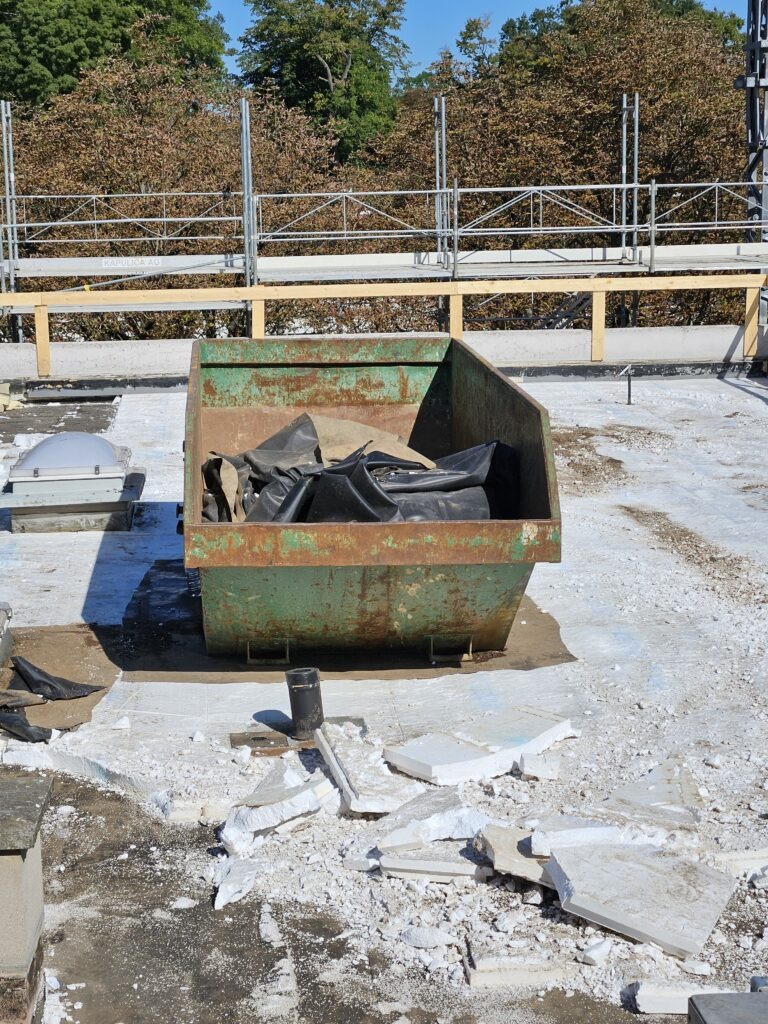
  • Sarnafil roofing membranes
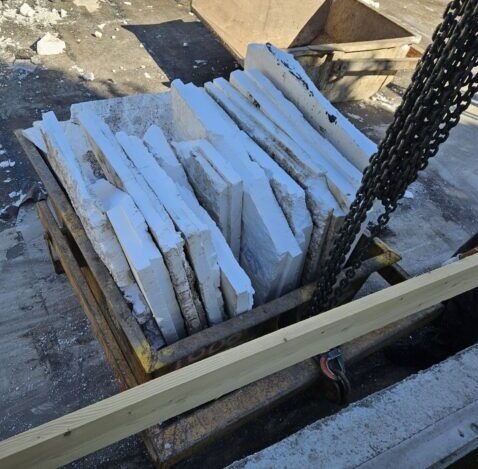
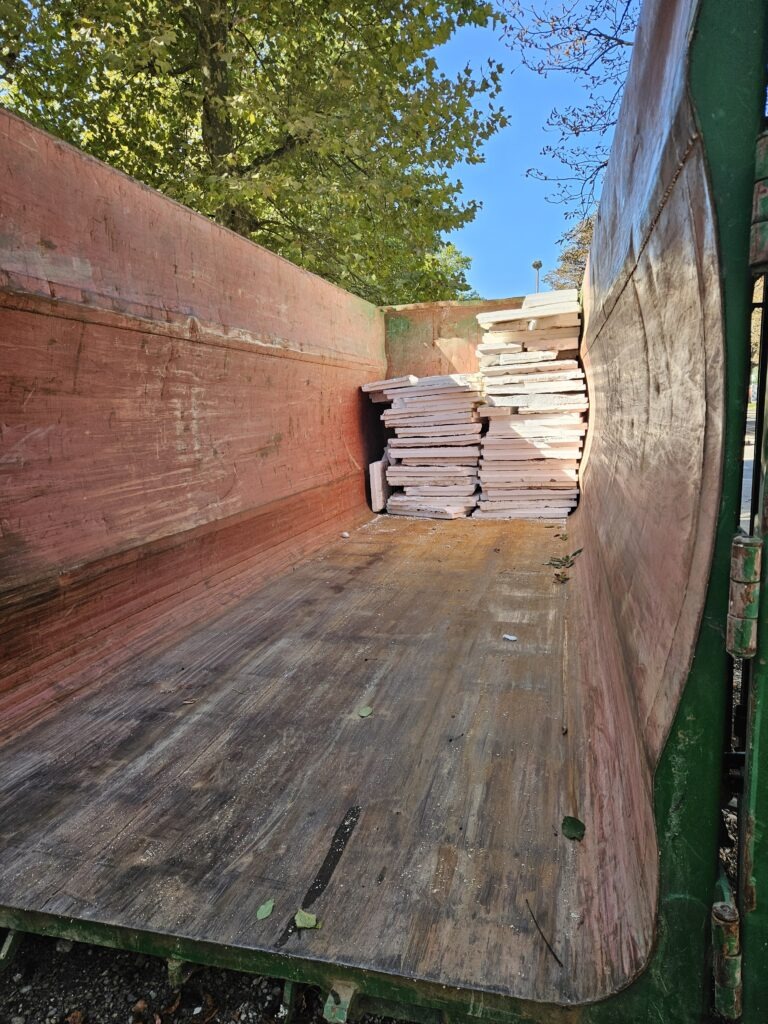
  • EPS roof insulation
  • XPS facade insulation
  • PVC flooring

Separate collection took place directly during dismantling and was evaluated in detail on the basis of work reports and discussions with the dismantling companies involved. The most important findings:

  • The separate collection of plastic fractions in dedicated skips can be easily integrated into the regular workflow of demolition companies.
  • Specific material knowledge is not required—separation can be carried out according to components.
  • The collection is largely based on the existing work steps; if space is limited, these can be coordinated in a targeted manner.
  • The effort required on the construction site is often more cost-effective than sorting the material later on.
  • While roof components were easy to remove, XPS facade insulation required more effort, as it had to be scraped off the wall. The most labor-intensive task was removing bonded PVC flooring.
  • Overall, the removal and transport of the four plastic fractions accounted for only around 1.5% of the total construction budget.
  • The effort involved depends heavily on the original installation method: loose roof insulation requires significantly less effort than bonded facade insulation.
  • Glued components also showed external contamination, which currently makes material recycling difficult.
Conclusion: Good feasibility – clear prospects

The test construction site clearly shows that the separate collection of plastic components directly on the construction site is technically feasible, organizationally integrable, and economically viable. With optimized workflows, there is hardly any additional effort involved.

In order to achieve a truly closed loop for construction plastics, the following is now needed above all else:

  • coordinated and efficient transport logistics,
  • High-performance recycling plants that are in tune with the market (also for the removal of harmful substances, such as flame retardants)
  • as well as deeper cooperation between all stakeholders.

The practical observations from Basel provide a valuable basis for this—and show that the transformation to a resource-efficient construction industry is already achievable today.

Sarnafil roofing membranes collected directly on the roof
Collection of EPS roof insulation on the roof for transport to the dumpster
Efficiently stacked EPS insulation boards in the transport trough
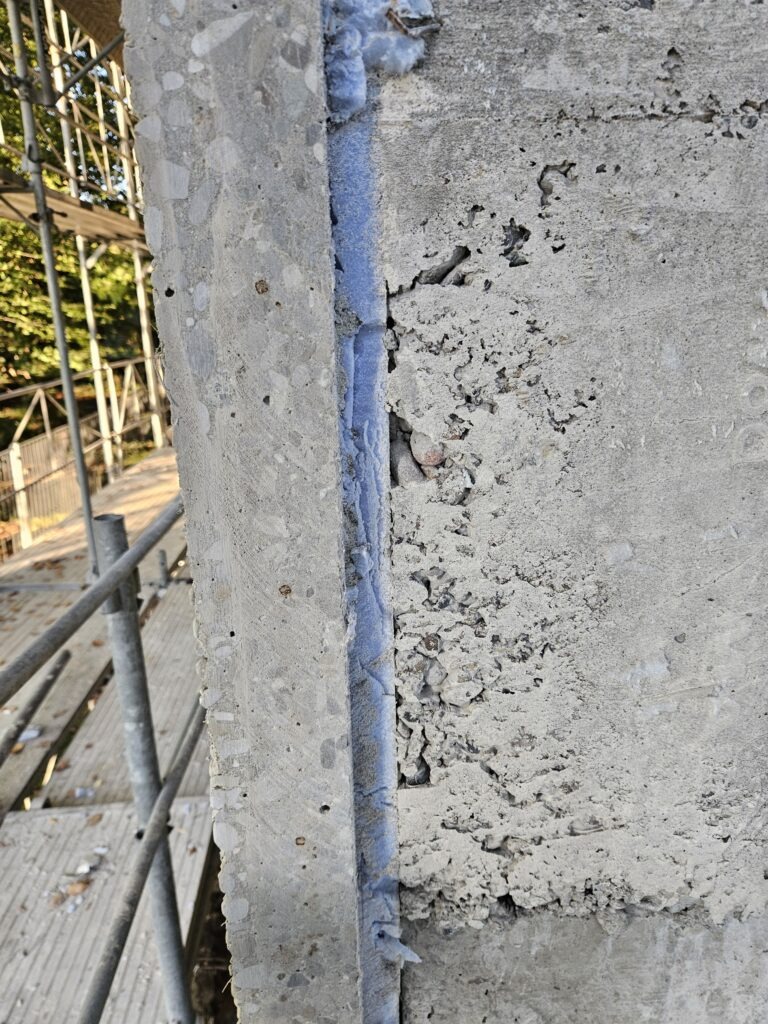
XPS facade insulation that is difficult to remove: thin, wedged in place, and glued on
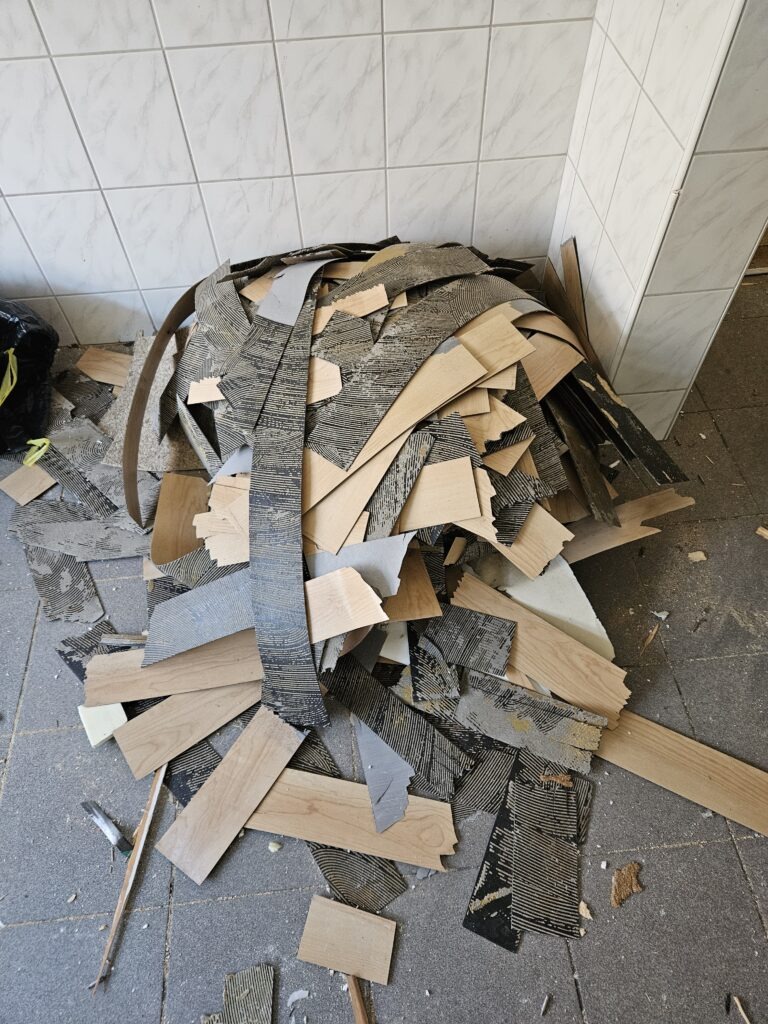
Removed PVC flooring in temporary storage; the adhesive residue is clearly visible.

This specific project has been completed. However, there are still some unanswered questions that can be clarified using test sites. Do you have a suitable test site? If so, please contact Maja Wiprächtiger and we will look into the possibilities together.

The most important questions and answers regarding the identification of potential test sites

What aspects are examined using the pilot construction sites?

To successfully recycle plastics in the construction industry – whether in new construction, renovation, or demolition – numerous process steps are necessary. Without a suitable concept, the separation of plastics by type, adapted logistics, and processing, the introduction of plastics into material recycling is neither economically viable nor technically feasible. With the pilot construction sites, we aim to investigate these various aspects and examine the individual process steps based on specific questions:

  • In the planning phase, the primary focus is on whether and how the separate collection of installed plastics can best be considered. This also involves how these efforts can be incorporated into the tendering of construction work and how much additional effort is actually generated by this additional planning.
  • In the execution phase, different approaches to the separate collection of plastics on the construction site will be examined. The focus here is on the questions of how much additional effort the separate collection entails and what skills, e.g., distinguishing between plastic products, are necessary for this. The local conditions/space constraints on the construction site, location of the construction site, etc. are also taken into account.
  • The sorting of plastics is an important step to enable recycling, as not every plastic can be used as a raw material for every plastic component. For the sorting step, we would like to compare two strategies: on the one hand, the direct sorting through separate collection of different plastic fractions on the construction site and, on the other hand, the subsequent sorting of a mixed plastic container in sorting facilities.
  • To close loops, it is not enough to just collect plastics. They must also be fed into effective recycling processes. Based on the collected plastic, we would like to check which additional steps are necessary for successful recycling. These include, for example, the removal of foreign bodies, the sorting out of materials with disruptive pollutants, or the clarification of logistical questions, such as how the material gets to the recycling plant.
  • In the case of a new building, we would investigate which factors promote the collection of product sections, for example, from pipes, and packaging.
How many and what type of construction sites are suitable?


  • Framework conditions: The presence of many plastics and the availability of a pollutant assessment are advantageous for gaining insights.
  • Type of construction site: Primarily suitable are renovations and demolitions of apartment buildings and office buildings. Other types of buildings are also possible in principle, but we see less potential for answering our questions (1st question). A new construction site would also be welcome, but the focus is on the recovery of demolition materials.
  • Time horizon: Ideally, the project is in the planning stage of execution and at least a few weeks before the start of work. This allows the most relevant questions to be identified together and then the work and necessary stakeholders to be optimally coordinated before the start of work.

Do you know of a potential construction site? Then contact Maja Wiprächtiger.

Where are plastics used in buildings and on construction sites?

The figure below shows where plastics are used in buildings. It is important for our test sites that plastics are available. Basically, the more the better, but not all of the plastic products listed here need to be available.

  • Floor coverings / Wall coverings
    In particular, floors made of PVC (polyvinyl chloride), also known as vinyl flooring, are common plastic floors with recycling potential. Sometimes such coverings are also used on walls. Stretch carpets are also made of polyester plastic.
  • Roof sealing membranes
    The sealing membranes on roofs can be made of plastic, mainly PVC (polyvinyl chloride), but sometimes also of other polymers such as FPO (flexible polyolefins).
  • Insulation material
    Insulation made of EPS (expanded polystyrene (Styrofoam)) and XPS (extruded polystyrene) are used as perimeter, facade and / or roof insulation. EPS is also used as impact sound insulation in floors, but these quantities are small compared to the thermal insulation.
  • Windows
    Window frames can be made of PVC (polyvinyl chloride).
  • Pipes / Cables
    Plastics are used for heating / cooling pipes, (waste) water pipes and as cable protection pipes.
  • Packaging
    Many building materials are delivered to construction sites in packaging. This packaging, especially films followed by buckets, can also be collected and recycled. Cartridges also fall into this category.

What is the process?

In a first step, it is determined whether and which plastics are present in the building in question. This usually requires a joint inspection with us. Depending on the situation, the identification of the plastics can also be taken over by the existing team of the construction project, for example, the planning engineering office. Based on the type of plastics, the building and the construction project, as well as the time horizon, we define the specific questions for this construction site together with the planners and, if applicable, the executing parties (see 1st question).

Depending on the questions, the subsequent process is different. However, ongoing coordination during the planning and execution phase is important.

Afterwards, we document the findings and prepare them in such a way that they are available to all interested parties.

What are the benefits of providing a pilot construction site?

By providing a construction site, you can contribute to the promotion of the circular economy in the construction industry. Pilot projects, such as the planned pilot construction sites, can help to reduce prejudices, e.g. regarding costs, and close gaps in knowledge. The findings gained from the pilot construction sites can be applied directly to further construction projects and thus contribute to the achievement of climate goals. Since a central part of a recycling system is the cooperation of actors along value chains, this also plays a major role in the pilot construction sites. Through your pilot construction site, you and your contractors will become part of the network, which can be valuable for future projects.

What additional costs are incurred in the construction project if it is used as a pilot construction site?

The overall coordination is carried out by us.

The following expenses are incurred for the construction project:

  • Effort for coordination with us
  • Effort for the inspection of the building with regard to the installed plastics
  • Time to answer our questions so that we can gather the experience

Depending on the issues, the following expenses are added:

  • Additional planning effort in advance and for the tender
  • Additional expenses for the separate collection of plastics on the construction site
  • Adapted logistics for transport to sorting centers, recycling plants or other customers

Financial costs incurred by the construction project: The exact additional costs during planning and execution depend on various factors, such as the size of the construction site, the planned approach, the issues to be investigated, and the scope of the work.

Monitoring the test sites and processing the results requires additional funding, which must come from you or possibly project partners.

What happens after the test construction site is completed?

We accompany the entire work during the test construction site, document it and compile the findings. These findings are continuously shared in the network and compiled at the end of the overall project in such a way that they are available to the general public.

Regular exchanges in the network not only serve to share the knowledge gained, but also to gather the experiences and ideas of other stakeholders and, where possible, to incorporate them into the test construction sites. In this way, everyone benefits from the knowledge and experience of other project partners in order to jointly take the first step towards comprehensive plastics recycling in Switzerland.

Within the framework of

title="Kontaktieren

Good day,
We are glad you are here!

We are delighted that you are interested in news about sustainable circular economy and realcycle. See you soon!
Your realcycle team.

We don't spam! Read our privacy policy for more information.